The call that started this
The homeowner called me in October 2024. They'd noticed a small discoloration on the drywall below a second-story window on the south-facing wall. Nothing dramatic—just a 3-inch watermark that appeared after heavy rain. They'd already had the roofer out, the siding guy out, and the window manufacturer out. Everyone had said the same thing: "Must be condensation."
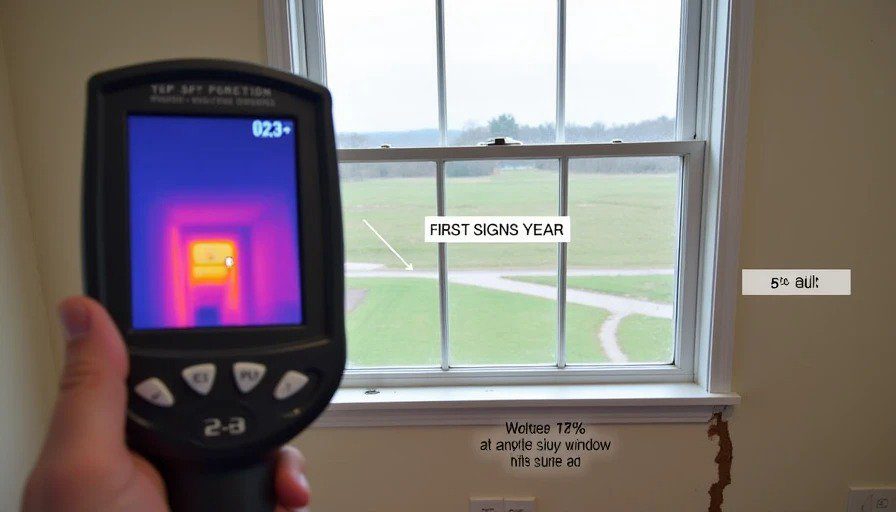
I brought the thermal camera. On a cool morning, the area below the window showed a temperature difference of 5°F compared to the adjacent wall. The moisture meter read 17% at the base of the stud cavity. Not a condensation issue. A leak.
We pulled the siding—HardiePlank, installed in 2019. The siding was intact. No cracks, no gaps, no visible damage. Then we peeled back the house wrap.
What I saw made me stop.
What the wrap looked like
The wrap was Tyvek HomeWrap. The red logo was still visible in places, faded but legible. The tape at the horizontal seams was still adhered. On the surface, it looked fine—intact, no rips, no holes.
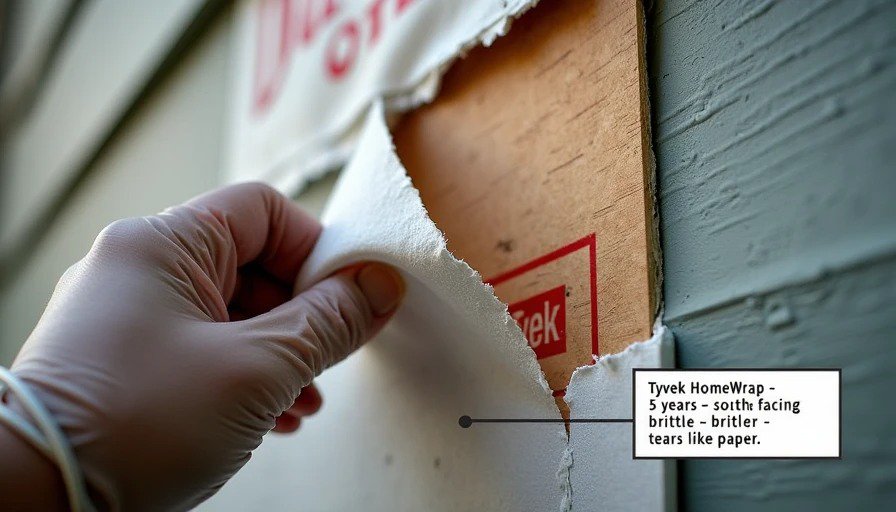
But when I lifted a corner to check the tape overlap, the wrap tore. Not at the tape line—the material tore. It came apart like wet paper, with a clean, fibrous tear that pulled through the entire sheet.
I peeled back a larger section. The wrap was stiff and brittle. Along the fold lines—where the wrap had been folded around corners and window openings—it had developed cracks. Not tears from physical stress. Age cracks. The material had lost all flexibility.
I folded a piece of the wrap in my hand. It cracked along the crease, with a clean break that was audible. The texture was papery, almost like heavy cardstock that had been left in the sun for a year.
This was five-year-old Tyvek HomeWrap. Installed in 2019. On a south-facing wall. In Golden, Colorado.
What the lab says about Tyvek
Let me be fair to the product.
Tyvek HomeWrap is a spunbonded olefin membrane. It's designed to block air and bulk water while allowing vapor to pass. In a climate-controlled lab, it's a solid product. It meets ASTM E1677 requirements for water resistance, air resistance, and vapor permeance. It has a 10-year limited warranty against manufacturing defects and a 6-month UV exposure limit before siding must be installed.
That 6-month UV limit is the key detail most homeowners miss.
The manufacturer says: install Tyvek, then install siding within 6 months. If it's exposed to UV beyond that, the material begins to degrade. The polyolefin fibers lose their flexibility. The surface becomes brittle. The water resistance begins to decline.
In a lab with controlled UV exposure, the 6-month limit is consistent with the known UV resistance of the material. The manufacturer has done the testing and written the limit into the product instructions.
But here's what the lab doesn't simulate: the UV that gets past the siding.
What actually happens in the field
On a south-facing wall in Colorado, UV intensity is significantly higher than in the lab's accelerated test. The angle of the sun, the altitude, and the number of cloudless days all contribute to more UV exposure per year than the test assumes.
Even after the siding is installed, UV gets through. It enters at the edges of the siding boards, through the nail holes, and through the gaps at corners and windows. It's not direct sunlight—it's diffuse, reflected, and scattered—but it's still UV. And it still degrades the wrap.
On a south-facing wall, after five years, the cumulative UV exposure behind the siding can be substantial. The wrap's fibers break down. The surface becomes brittle. The material loses its ability to flex with the building's movement and thermal expansion.
In the Golden house, the south-facing wall was exposed to all-day sun. The wrap had been installed in summer 2019, and the siding followed within two months—well within the manufacturer's 6-month window. The exterior was intact. The UV exposure behind the siding came from the small gaps at the siding joints and around the window trim.
Five years later, the wrap was structurally compromised. It wasn't torn—it was brittle. It had lost its flexibility and its ability to seal around nail penetrations. Water that tracked behind the siding could pass through the wrap where the fibers had broken down.
The water path
Here's how the water got into the wall.
The window itself was intact. The flashing around the window was properly detailed—a pan flashing at the sill, side flashes, a head flashing. The tape at the seams was still adhered. Water wasn't entering at the window.
Water was entering through the siding at the bottom of the wall—about 6 inches below the window. The HardiePlank siding had a small gap at the bottom where the trim met the foundation. That gap was designed to allow water to drain, not to let water in. But wind-driven rain had pushed water upward into the gap, behind the siding, where it contacted the wrap.
On a south-facing wall, wind-driven rain is common. In a Colorado thunderstorm, rain can be driven horizontally at 40-50 mph. It pushes water up under the siding, into the gap, and against the wrap.
If the wrap were intact and flexible, the water would run down the wrap's surface, drain out the bottom, and not enter the wall. The water barrier function of the wrap would hold.
But on a south-facing wall, the wrap had become brittle. It had lost its surface integrity. Water contacted the wrap, sat against it for hours, and wicked through the degraded fibers—not through a tear, but through the material itself. The wrap's water resistance was compromised by UV degradation, even though it had never been directly exposed to sunlight.
What the rest of the wall looked like
We cut open the full wall—from the window sill down to the foundation—to see the full extent of the damage.
The OSB sheathing behind the wrap was stained dark. The moisture meter showed 18% at the bottom edge, trailing down to 14% at the mid-point of the stud cavity. The staining followed the same pattern: higher at the bottom, tapering off as you went up.
We removed the bottom 24 inches of sheathing. The OSB was soft and crumbly at the bottom edge—early rot, not advanced, but advanced enough that it had lost structural integrity. We replaced the bottom section of sheathing and the sill plate, which had discoloration but was still structurally sound.
The studs were dry but stained. The moisture had been there, but it hadn't penetrated deep enough to reach the structural core of the studs. The framing was salvageable.
The damage was localized to the bottom 2 feet of the wall—exactly where the wind-driven rain had contacted the wrap. The wrap had failed at that point, and water had wicked up into the sheathing.
What I've seen on other jobs
This wasn't an isolated case.
I've done five similar cut-open inspections in the Denver area over the last three years. In four of them, the house wrap—Tyvek HomeWrap—had degraded on the south-facing wall, losing flexibility and water resistance within 5 to 7 years of installation.
In the fifth house, the builder had used Tyvek CommercialWrap—the thicker, denser, more UV-resistant version. That wrap was still flexible and intact after 6 years on the south-facing wall. The homeowner had paid a premium for the upgrade, and it had clearly paid off.
I've also seen the same degradation on east-facing and west-facing walls, but it's slower. The south-facing wall is the worst, because it gets the most UV exposure.
The pattern is consistent: south-facing walls, UV degradation, wrap loses water resistance by year 5 to 7. North-facing walls typically last much longer—I've inspected 10-year-old north-facing walls where the Tyvek was still flexible and intact.
The manufacturer's position
Tyvek's position is clear: the wrap is designed to be covered within 6 months. If it's covered, it should last for the life of the building. The product spec says it will resist water and air for decades, as long as it's protected from UV.
The problem is that the protection isn't perfect. UV gets through the siding. The wrap is protected from direct sunlight, but not from diffuse UV. And the manufacturer's warranty is against manufacturing defects—not against UV degradation.
In the Golden house, the wrap was covered within 2 months. The manufacturer would likely say that the product performed as intended, and that any degradation after 5 years is outside the scope of the warranty. The problem isn't the product—it's the exposure conditions, which are more severe in Colorado's high-altitude, high-UV climate.
I don't disagree with that position. But it means that, in Colorado, a standard Tyvek HomeWrap on a south-facing wall has a field-observed useful life of about 5 to 7 years for water resistance. That's different from the lab's estimate.
What I spec now
After seeing this failure repeatedly, I've changed my specifications for Colorado projects:
On any south-facing wall, I spec Tyvek CommercialWrap or a fully adhered WRB (like Henry's Blueskin or similar). The CommercialWrap's thicker fibers and denser structure resist UV degradation better. The fully adhered WRB provides a continuous, non-woven barrier that doesn't rely on the integrity of the spunbonded fibers.
On any wall with cementitious siding (HardiePlank, cement board, or fiber cement), I spec a drainage layer between the siding and the wrap. The drainage layer—like Benjamin Obdyke's HydroGap—creates a capillary break that prevents water from sitting against the wrap. It also allows water that does get behind the siding to drain down and out, not sit against the wrap's surface.
On any wall in a high-exposure area (south-facing, west-facing, exposed to wind-driven rain), I spec a minimum 7-year UV-resistant WRB. The material should be tested for UV resistance specifically, not just for water resistance.
The cost difference between Tyvek HomeWrap and CommercialWrap is about 15-20% on material. The drainage layer adds about 10-15% more. The total premium for a WRB that will actually hold up on a south-facing wall is about 25-35% of the wrap and drainage budget.
That sounds like a lot. But in the Golden house, the cost of the repair was about $2,800—for the sheathing replacement, the reframing, the flashing, and the new wrap. The premium for CommercialWrap and a drainage layer, across the whole house, would have been under $800. The homeowner paid $2,800 because the builder used the standard product on a south-facing wall.

No notes on this sheet yet.