What ZIP does right
Let me be upfront: ZIP is a genuinely good product.
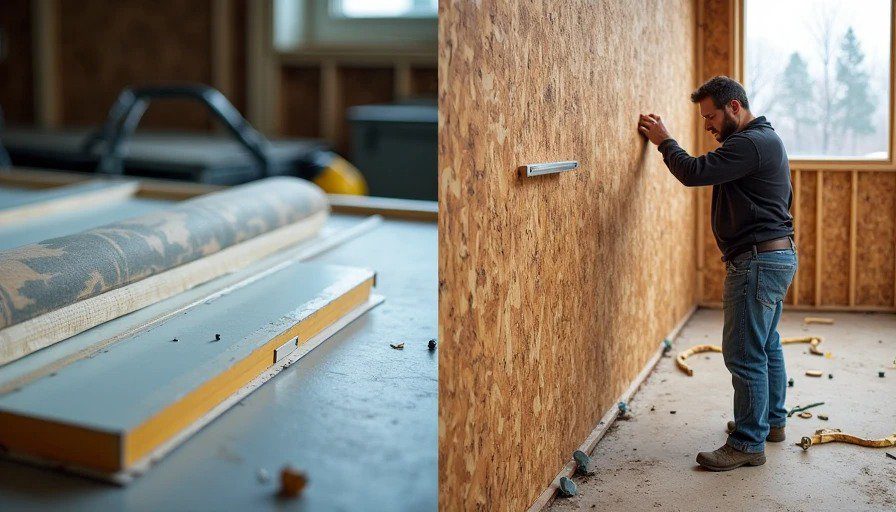
Huber Engineered Woods got something right when they put the WRB (water-resistive barrier) on the panel at the factory, instead of trusting a crew on site to wrap the house correctly with housewrap and tape every seam. The ZIP system eliminates a full trade. It reduces the number of steps where something can go wrong. And when it's installed correctly—perfectly flat substrate, proper fastener pattern, seams rolled with the proprietary tape, temperature above 25°F—it forms a remarkably tight, water-resistant shell.
I've specced it on jobs. I've installed it on jobs. I've used it on my own house.
In the lab tests I used to run, ZIP panels performed beautifully. The integrated WRB has a perm rating that allows drying while blocking bulk water. The tape adhesion tests came back strong. The nail seal properties were consistent. On paper and on test racks, ZIP works.
But here's where the lab tests stop, and the real world begins.
Problem 1: The tape is the weakest link
The ZIP system hinges on one thing: that acrylic tape, rolled with a special tool, bonding the panel seams and flashing details. Without perfect tape adhesion, the WRB has a thousand tiny holes where water can find its way in.
In the lab, the tape is applied to a clean, dry, dust-free panel surface. The ambient temperature is controlled. The roller pressure is measured. Everything is textbook.
In the field, here's what actually happens:
Dust and debris settle on the panel surface before the tape goes down. The panels are delivered, stacked, and often sit on site for days or weeks before installation. Sawdust, sand, dried mud from boots, and the fine grit that gets blown around every job site. The tape is supposed to be applied to a "clean, dry, frost-free surface" per Huber's own instructions. "Clean" in the field means something very different than "clean" in the lab.
Cold-weather installation is a genuine problem in Colorado. ZIP tape has a minimum application temperature of 25°F. That's fine for Denver summers and falls. But I've walked more than a few job sites in March where the morning temperature is 18°F and the crew is taping seams anyway because the schedule says they have to. The adhesive doesn't wet out properly at low temperatures. It doesn't flow into the panel surface. It sits on top, cold and stiff, and three months later when the freeze-thaw cycles start, it lifts.
Uneven substrate is the one most people don't think about. OSB panels are flat in the lab. On a real roof, framing lumber cups, trusses aren't perfectly aligned, and the panel surface often has a slight crown or valley at the seams. That gap—even a 1/16-inch difference in plane—creates a bridge where the tape spans a void instead of bonding to a solid surface. Water finds that bridge eventually.
I saw a job two years ago where the ZIP tape looked perfect from the ground. Six months in, the homeowner noticed a dark streak on the exterior wall below a window. The tape had lifted at a seam where the OSB had a slight crown. Water wicked in, saturated the sheathing edge, and started to rot. The rest of the house was fine. That one seam was the failure point.
Problem 2: Nail penetrations aren't self-sealing—not forever
ZIP panels are engineered so that the fasteners—nails or screws, depending on the application—penetrate the WRB and the panel, and the foam gasket on the fastener is supposed to seal the penetration.
In the lab, the nail is driven at a perfect 90-degree angle, flush to the surface, with consistent pressure. The seal is reliable.
In the field, the framing nailer is being operated by a human who has been on the gun for three hours straight. Some nails are overdriven. Some are slightly angled. Some are in the wrong location because the stud behind the panel shifted.
Every nail that's overdriven is a hole where the foam gasket is compressed beyond its design limit. Every angled nail is an oval penetration, not a round one—and oval holes don't seal as well. Every missed stud that gets pulled and re-nailed leaves an unsealed penetration behind the panel, invisible from the outside, that water finds eventually.
I don't have a perfect fix for this. The solution is good crew supervision and disciplined nailing patterns. But I've seen enough ZIP jobs to know that the lab's "self-sealing fastener" promise assumes a level of installation precision that simply doesn't exist on most job sites.
Problem 3: The panels themselves absorb moisture—at the edges
This is the one that drives me crazy.
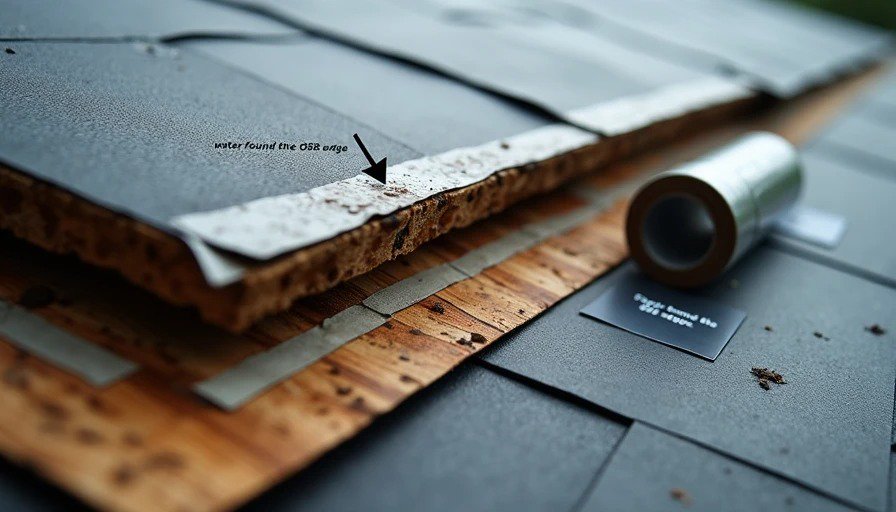
ZIP panels are OSB—oriented strand board. And OSB, despite being engineered, is still a wood product. The edges of each panel are the most vulnerable point for moisture intrusion. Huber applies a coating to the panel surface—that's the WRB layer—but the raw edge of the panel is exposed at every seam.
If the tape fails at a seam—and as we established above, tape fails with some regularity—water gets into the exposed edge of the OSB. That edge swells. The swelling breaks the tape bond further. Water gets deeper into the panel. Over time, the edge of the panel rots, and the ZIP system's integrity goes with it.
I've pulled ZIP panels off roofs where the edges were so swollen you could see the delamination starting. The WRB was intact on the face of the panel. The failure was at the tape-over-edge seam. The water found that edge, and the OSB drank it up like a sponge.
Huber's installation instructions are very clear about sealing the edges: in high-wind and high-moisture regions, you're supposed to tape the seams. That's what the tape is for. But the tape is only as good as the bond, and the edge of an OSB panel is a rough, uneven surface that doesn't bond as well as the smooth face of the panel. That's a fundamental design limitation that no installation instruction can fully overcome.
Problem 4: The "drying" claim that doesn't account for Colorado
ZIP's marketing emphasizes that the panel is breathable—the WRB allows vapor to pass, so the sheathing can dry to the exterior. In theory, that's correct. The perm rating of the ZIP WRB is high enough to permit drying.
But in Colorado, the drying equation is different.
Our low humidity is a double-edged sword. Yes, it helps wood dry faster than in coastal climates. But low humidity also means the OSB starts dry—often below 8% moisture content—and OSB that dry is more brittle, more prone to edge swelling when it does get wet, and less forgiving of expansion and contraction cycles.
Furthermore, the ZIP system relies on the WRB to block liquid water while allowing vapor to escape. That's great when the water is occasional and the drying cycle is quick. But if the panel gets wet at the edges, and the tape is compromised, the water is trapped behind the WRB, on the face of the OSB, and the drying cycle isn't as reliable as the marketing claims.
I've been on roofs where the ZIP WRB was performing fine, but the OSB behind it was at 18% moisture content because water got in at the tape joints and couldn't dry out fast enough. The WRB itself was intact. The system was still failing, just behind the face.
The IR camera never lies
One of the reasons I carry a thermal imaging camera on every job site is that it tells me what the surface can't.
I was on a job last spring where the ZIP sheathing had been up for about 18 months. From the outside, it looked clean. The tape was intact. The panels were straight. The builder was proud of the work.
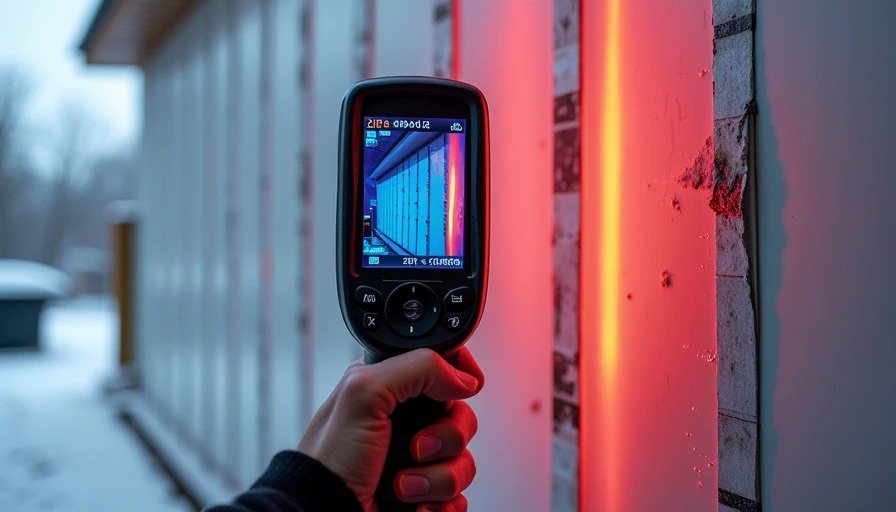
I walked the roof with the IR camera on a cold morning—about 20°F with a light frost. What I saw on the screen told a different story: dark streaks running along several panel seams, indicating moisture trapped behind the WRB. The tape had held visually, but water had found its way in, and the OSB had taken on enough moisture to show up as a thermal lag.
I pulled a nail at the edge of one seam, carefully peeled the tape back, and found it: the OSB edge was swollen, discolored, and soft to the touch. Water had been getting in for months—through a tape seam that looked perfect from the ground.
The builder had done everything right, or at least everything he thought was right. The installation was by the book. The failure happened anyway, because ZIP is a system that relies on perfect conditions, and perfect conditions don't exist on Colorado job sites.
When does ZIP still make sense?
I'm not telling you to avoid ZIP. I'm telling you to treat its marketing claims with the same healthy skepticism I treat every product.
ZIP makes sense on large custom homes where the owner is willing to pay for premium installation, where the crew is diligent and supervised, where the tape is applied properly, and where the budget allows for the extra cost.
ZIP makes less sense on spec homes and production tract housing, where crews are paid by the piece, installation is fast and sloppy, and the tape often goes down on dusty, cold panels because the schedule demands it. In that environment, I'd rather have traditional housewrap with the seams independently taped, because at least you can inspect it more easily.
ZIP makes sense in dry climates like Colorado's—if, and only if, the installation details are dialed in. The drying potential is real. But the edge-swelling problem is also real, and it's not going away.
ZIP makes less sense in high-moisture coastal climates, where the OSB is at constant risk of edge swelling and the drying cycles aren't fast enough to compensate. That's not our problem in Denver, but it's worth noting if your scope extends beyond the Front Range.
The verdict on ZIP
ZIP sheathing is a great product. It was designed with genuine intelligence and solves real problems on the job site. Its lab test performance is solid, and when installed with precision, it can deliver excellent results.
But it's also a product whose field performance depends entirely on installation quality—and installation quality is the one variable that no lab test can guarantee. The tape fails at edges. The nails don't always seal. The OSB edges swell when they get wet. And Colorado's freeze-thaw cycles will exploit every single weakness in that system over time.
If you spec ZIP, spec it with clear installation details, in writing, and hold the crew accountable. Walk the roof with an IR camera. Check tape adhesion at the edges. Look for any seam that seems slightly crowned or uneven. The product will do its job. The question is whether the people installing it will do theirs.
No notes on this sheet yet.