What I used to do in the Intertek lab
Before I was a GC, before I was crawling around Denver attics with a thermal camera, I was the guy in the lab running freeze-thaw tests on concrete masonry units, precast panels, and poured-in-place samples.
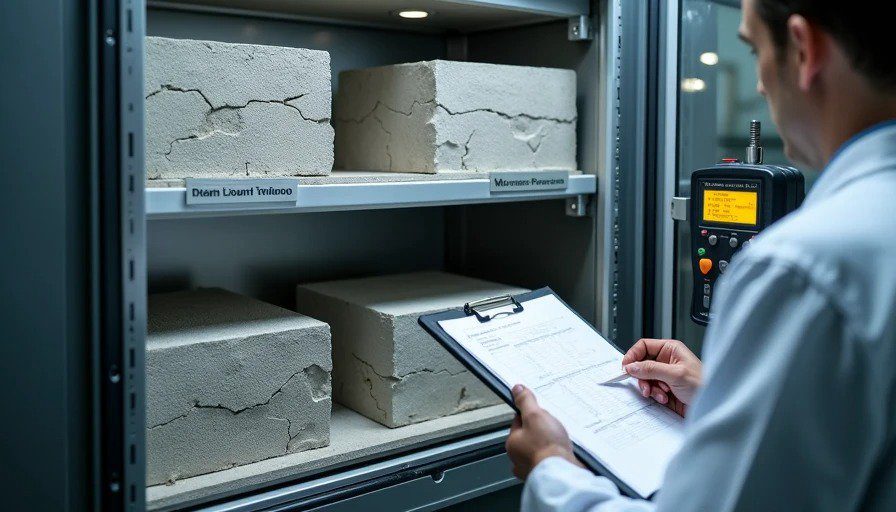
Manufacturers sent us samples. I'd cut them to test size, measure initial weights and ultrasonic pulse velocities, and then load them into the freeze-thaw cabinet.
The cabinet was basically a heavy-duty freezer with a water bath and a programmable controller. The standard test—ASTM C666, Procedure A—goes like this:
Cycle starts at 40°F.
The freezer drops the sample temperature to 0°F over a period of 2-3 hours.
The sample sits at 0°F for 1-2 hours.
The freezer warms back up to 40°F for 2-3 hours.
Repeat. 300 times. Or until the sample falls apart.
Every 50 cycles, we pulled samples out, weighed them, measured their length change, and ran ultrasonic pulse velocity to check for internal cracking.
I ran this test on everything: lightweight concrete block, heavyweight architectural precast, colored concrete, air-entrained concrete, and non-air-entrained concrete. I saw the full range of results: samples that survived 300 cycles with barely a scratch, and samples that disintegrated by cycle 60.
What happens in the first 50 cycles
The first 50 cycles are the deception phase.
If a concrete sample has been properly air-entrained—meaning it contains microscopic air bubbles, typically 4-8% by volume, that provide space for freezing water to expand into—it will survive the first 50 cycles without visible damage. The weight change is minimal. The ultrasonic pulse velocity stays stable. A visual inspection reveals no surface scaling, no cracking, no significant loss of integrity.
If the sample has no air entrainment, things are different. By cycle 30, the sample usually shows visible surface scaling. By cycle 50, small cracks appear at the corners. The sample is already heading downhill.
But the real driver of failure at this stage is critical saturation. Concrete needs to be saturated to about 91.7% of its total porosity before the freeze-thaw cycle causes damage. In a wet climate—or in a concrete sample that has been fully submerged in water during the test—that saturation threshold is reached very quickly. Once critical saturation is reached, the freeze-thaw damage mechanism kicks in: water freezes, expands by 9%, creates internal pressure, cracks the matrix, and the cracks fill with more water, ready for the next cycle.
In the first 50 cycles, the damage is microscopic. The cracks are too small to see with the naked eye. But the ultrasonic pulse velocity measurement tells the story—the internal structure is beginning to break down.
What happens between 50 and 100 cycles
This is where the spiral starts.
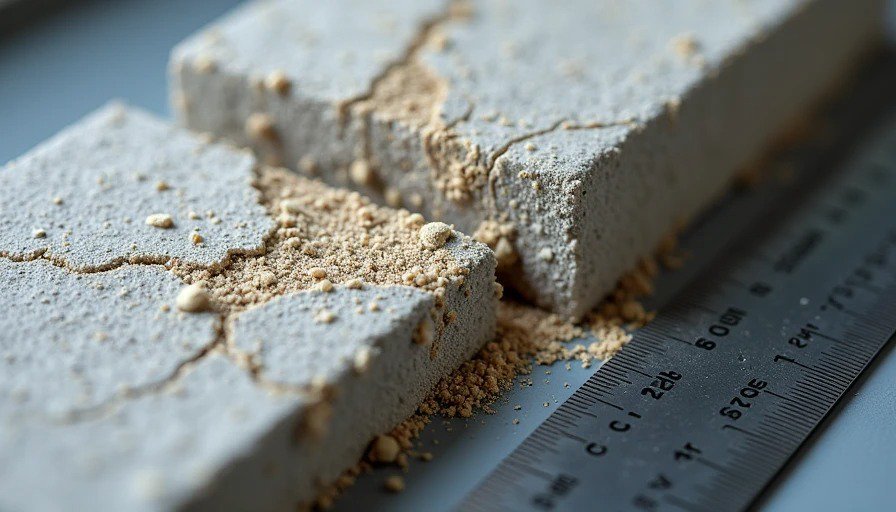
By cycle 60-70, I'd start to see visible surface scaling on most non-air-entrained samples. The surface would lose its smooth finish and develop a sandy, granular texture. The scaling was localized at first—usually on the top surface, where the concrete had been exposed to the most severe freeze-thaw stress.
For air-entrained concrete, the damage was slower but still visible by cycle 80-90. The surface would begin to show small flakes—very fine material that would brush off with a finger.
But the real change was inside the sample. The ultrasonic pulse velocity data would start to show a measurable decline—indicating that the sample's internal structure was becoming more porous, less dense, and more vulnerable to further damage.
By cycle 100, a non-air-entrained sample would have lost 15-25% of its original dynamic modulus of elasticity—a measure of the concrete's stiffness and structural integrity. The sample was still intact, but it was compromised.
What happens between 100 and 150 cycles
This is the death zone.
By cycle 120-140, the cracks would become visible to the naked eye. I'd see small cracks radiating from the corners, along the edges, and across the surface of the sample. The cracks were usually 0.5-1mm wide—narrow enough to not be visible from the distance, but clearly present.
The weight change became meaningful at this stage. Samples would start losing significant mass—1-3% over the course of 50 cycles. Not from chemical decomposition, but from the physical breakdown of the matrix: the surface was flaking away, the edges were crumbling, and the sample was shedding material.
The ultrasonic pulse velocity measurement would drop to 50-60% of the original value. The sample was now a fraction of its original strength. It would still hold together—barely—but it had lost most of its load-bearing capacity.
For non-air-entrained samples, this was often the end. By cycle 150, many would have failed entirely—either splitting into multiple pieces or becoming so weak that they couldn't survive the handling involved in removing them from the freeze-thaw cabinet.
I'll never forget one sample: a concrete block that had been tested at about 130 cycles. I reached in to take it out of the cabinet, and it just crumbled in my hands. No warning. One second it was intact. The next second, it fell apart like dry dirt. The freeze-thaw cycles had turned the interior into a matrix of microcracks, and the handling force was enough to exceed the remaining cohesion.
What happens between 150 and 200 cycles
By 150 cycles, even the air-entrained samples would show significant surface damage.
The scaling would be extensive—often covering 30-50% of the exposed surface. The edges would be rounded and soft. Small chunks of the sample—the size of a pea or larger—would break off during handling.
The non-air-entrained samples, if they'd survived to this point, would be unrecognizable. Surface scaling, severe cracking, loss of shape, and loss of mass. Some would have split into multiple pieces. Others would be so weak that they'd fail under their own weight.
At 200 cycles, the test is effectively complete. ASTM C666 calls for 300 cycles, but many samples don't make it that far. The ones that do make it to 300 are almost always air-entrained samples that were properly mixed, placed, and cured.
But here's the critical point: even the samples that survived 200 cycles with air entrainment show measurable degradation. They've lost 15-25% of their dynamic modulus. They've lost 2-5% of their mass. Their surface is scaled and roughened. They're structurally weaker than when they started.
What the lab test doesn't simulate
The ASTM C666 test is rigorous. It's the best standardized test we have for freeze-thaw durability.
But it doesn't simulate reality.
The lab test uses water-saturated samples. In the field, concrete isn't always at critical saturation. It cycles between wet and dry, depending on the weather. The lab test accelerates the freeze-thaw damage by keeping the sample fully saturated for the entire test. The field exposure is less severe—but the field damage is also more variable, more localized, and often caused by factors the lab test doesn't include.
The lab test doesn't simulate de-icing salts. The test uses pure water, not road salt, brine, or calcium chloride. De-icing salts accelerate freeze-thaw damage dramatically. The salt reduces the freezing point, so the concrete experiences more freeze-thaw cycles at a wider range of temperatures. It also reacts chemically with the cement paste, breaking down the matrix faster.
The lab test doesn't simulate freeze-thaw cycling in the field. A real Colorado winter includes rain, snow, melt, freeze, thaw, and re-freeze, all with varying rates, varying temperatures, and varying exposure to de-icing salts. The lab test is uniform—the temperature drops from 40°F to 0°F and back, every single cycle, for 300 cycles.
The lab test measures "initial" performance. The sample is mixed in a lab, cured under controlled conditions, and tested at its peak strength. Field concrete is mixed on-site, placed by contractors, and cured in less-than-ideal conditions. The field concrete's frost resistance is often lower than the lab sample's—sometimes significantly lower.
What 200 cycles actually means in the field
One freeze-thaw cycle in the lab equals about 24 hours of accelerated freezing and thawing. In the field, a Colorado Front Range winter typically delivers 100-200 freeze-thaw cycles per season. So a sample that survives 200 cycles in the lab is roughly equivalent to a year of normal weather—compressed into a single test.
But field performance doesn't line up perfectly with lab performance. I've walked onto job sites and found concrete that was 10 years old and looked perfect. It had been exposed to 10 seasons of freeze-thaw—roughly 1,000-2,000 field cycles, depending on the winter.
The difference? Air entrainment and proper placement. The concrete that held up had 5-6% air content, was mixed consistently, placed carefully, and cured with adequate moisture. The concrete that failed by year 5 had low air content, was placed in freezing weather, or was cured poorly.
What I've seen, year after year, is that field performance aligns with lab performance when the concrete is properly engineered and properly installed. The lab test, for all its limitations, still predicts field performance with reasonable accuracy—if the concrete in the field matches the concrete in the lab.
The problem is, field concrete often doesn't match the lab sample. The mix design drifts, the air entrainment agent is under-dosed, the curing conditions are less ideal, the placement occurs in colder weather than the lab sample. All of these variables shift the concrete's performance toward the low end of the range.
The four stages of freeze-thaw failure in the field
Based on what I've seen in the lab and what I've observed in the field, concrete failure from freeze-thaw follows a predictable progression:
Stage 1: Surface scaling (year 1-3)
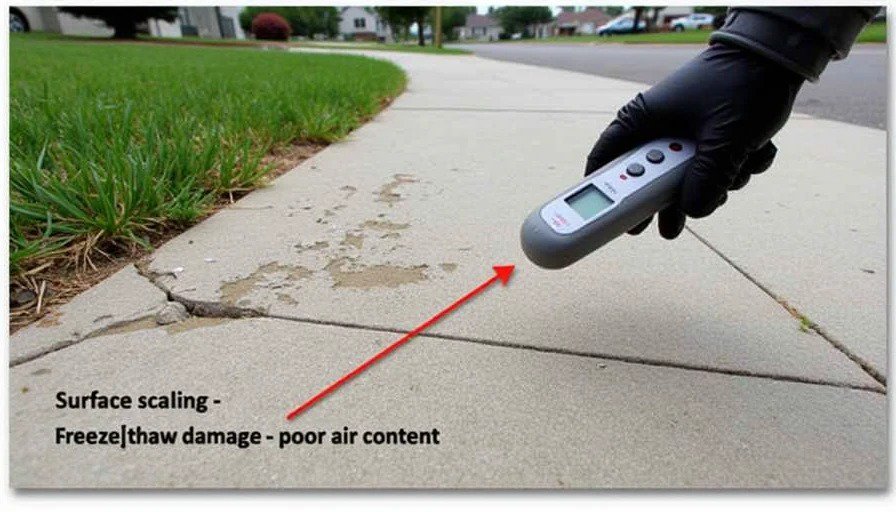
The surface of the concrete becomes roughened, sandy, and begins to flake. The fines—the small aggregate particles—start to appear on the surface as the cement paste breaks down. This is usually the first visible sign of freeze-thaw damage.
Stage 2: Fine cracking (year 3-7)
Small cracks appear on the surface, often in a random pattern. These are called "map cracking" or "spiderweb cracking." They're typically very fine—less than 1mm wide—and are often only visible when the surface is wet. These cracks allow more water to penetrate, accelerating the freeze-thaw damage.
Stage 3: Coarse cracking (year 7-12)
The cracks widen to 1-2mm and begin to follow the coarse aggregate. The concrete starts to split along the aggregate-cement paste interface. At this stage, the concrete is visibly deteriorating and often shows signs of spalling—the loss of sections of concrete.
Stage 4: Failure (year 12-20)
The concrete is structurally compromised. The surface is heavily scaled, the edges are soft and crumbling, and the concrete has lost much of its load-bearing capacity. In extreme cases, the concrete can fail catastrophically—a sidewalk that crumbles underfoot, a driveway that breaks apart, or a foundation that develops visible cracks.
Note: These timelines assume moderate freeze-thaw exposure and moderate maintenance. In severe conditions—exposure to de-icing salts, poor drainage, low air content—the timeline can be shortened to 5-10 years. In protected conditions with minimal wetting, the timeline can be extended beyond 20 years.
What I look for in the field now
When I'm inspecting a concrete structure in the Denver area, I look for the early signs of freeze-thaw damage:
Surface scaling: The top surface is rough, sandy, or flaking. This is the earliest sign that the concrete has been exposed to severe freeze-thaw cycles and is beginning to fail.
Fine cracks: The map cracking or spiderweb pattern that appears on the surface. Often a sign that the concrete has poor air content or insufficient air entrainment.
Spalling: The loss of concrete pieces from the surface or edges. This indicates that the freeze-thaw damage has progressed to a point where the concrete can no longer resist the internal pressure.
Edge damage: The corners and edges are soft, rounded, or broken. This is often the first area to fail, as they're exposed to the worst freeze-thaw conditions—water collects at edges and corners, and the freeze-thaw cycles are more severe at these points.
Efflorescence: The white, chalky deposit that forms on the surface as water migrates through the concrete. This isn't freeze-thaw damage itself, but it's an indicator that water is moving through the concrete, which is a precondition for freeze-thaw damage.
What you can do to avoid this
If you're pouring concrete in a cold climate, here's what you need to do to avoid freeze-thaw failure:
Specify air-entrained concrete. The air content should be 4-8% by volume. Air entrainment is the single most important factor in freeze-thaw durability. A properly air-entrained concrete will survive 300 freeze-thaw cycles in the lab; a non-air-entrained concrete will fail in 50-100.
Confirm the air content at the job site. Don't just spec it. Test it. The contractor should have a field test kit to measure air content on-site. If they can't show you the result, the concrete may not have the required air content.
Protect the concrete during curing. Concrete needs moisture to cure properly. If the concrete dries out too quickly, the hydration reaction stops early, and the concrete's strength and frost resistance are compromised. Use curing blankets, wet burlap, or a curing compound to maintain moisture for at least 7 days.
Avoid pouring in cold weather. If the air temperature is below 40°F, the concrete's hydration reaction slows down significantly. If the temperature drops below freezing before the concrete has reached 500 psi strength, the water in the mix will freeze, creating internal voids that reduce strength and frost resistance. Use hot water in the mix, use chemical accelerators, or wait for the weather to warm up.
Seal the surface after curing. A sealer reduces the concrete's absorption of water, lowering the risk of critical saturation and freeze-thaw damage. Use a penetrating sealer, not a surface coating, for best results.

No notes on this sheet yet.