The spec sheet that started this
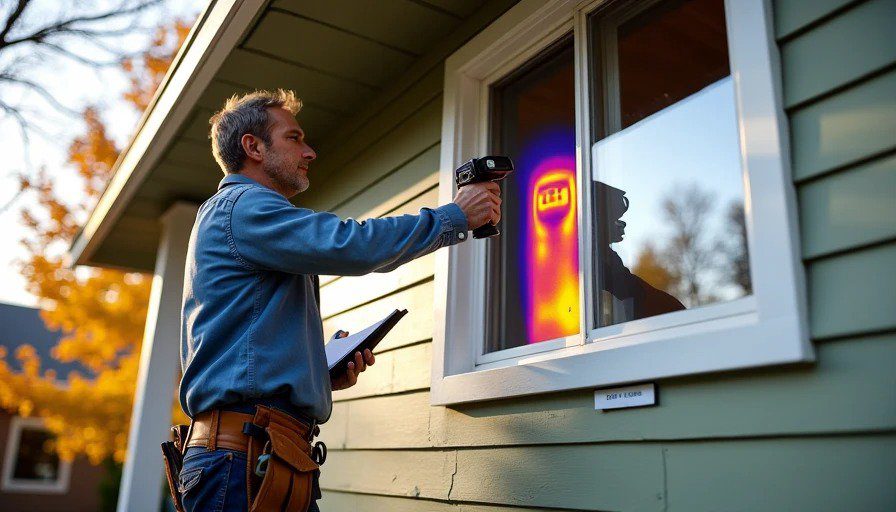
I was on a job last February. New build in Parker, about 20 miles south of Denver. The homeowner had spec'd R-21 fiberglass batts in the 2x6 exterior walls. The insulation was in. The drywall was up. The house was framed, wrapped, sided, and buttoned up.
I was there for a pre-drywall walk on a different issue, but I had the thermal camera in the truck. The morning was cold—about 12°F, with a clear sky after a light overnight snow. Perfect conditions for thermal imaging.
I walked the interior walls with the camera, just scanning for framing anomalies before the drywall went on. What I saw didn't match the spec.
The studs showed up as bright vertical lines—thermal bridging, exactly what you'd expect. But the cavity between the studs? It wasn't as evenly dark as it should have been. Instead of a uniform insulation layer, I saw patchy thermal patterns—some areas dark, some notably lighter, even within the same cavity.
I flagged it for the homeowner. We opened a section of drywall before it got taped and mudded. What we found underneath wasn't a batt failure. It was something more common, and more insidious.
What the camera sees that the spec sheet doesn't
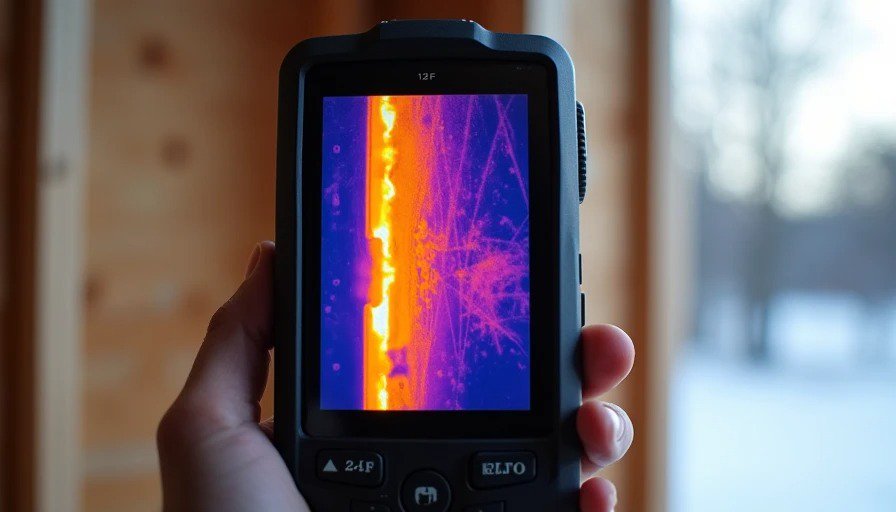
A thermal camera doesn't measure R-value directly. It measures surface temperature. And surface temperature, on a cold morning with a known indoor temperature, gives you a proxy for how much heat is moving through that assembly.
The math is straightforward: If a wall cavity has R-21 insulation performing at R-21, the interior surface temperature will be relatively uniform. If sections of that cavity are underperforming, the surface will be warmer in those spots—heat is escaping faster, and the drywall is picking up that heat.
On the Parker house, the temperature difference between the coldest cavity and the warmest cavity was almost 8°F. That's not a small anomaly. That's a meaningful performance gap.
When I pulled the batts, I found three things:
Compression. The R-21 batts were designed for a 2x6 cavity, which is nominally 5.5 inches deep. In several cavities, the batt had been forced into a cavity that was actually 5.25 inches—common with kiln-dried framing that's a hair undersized. That quarter-inch of compression reduced the effective R-value by about 10-12%. The spec sheet assumes the batt is at full designed thickness. The field installation compressed it, and the camera caught the result.
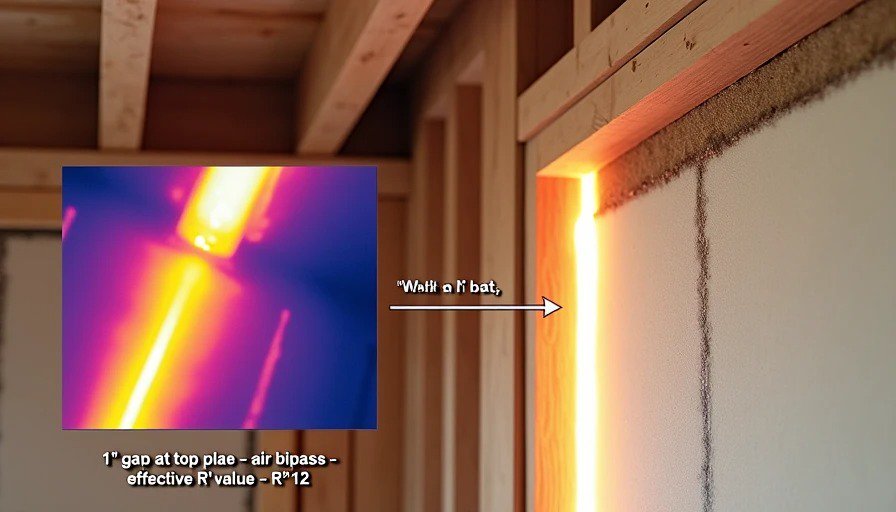
Gaps at the top and bottom plates. In the Parker house, the batts had been cut in the field, and in four cavities the installer had left about an inch gap at the top of the stud bay. Warm air was moving up behind the drywall, bypassing the batt entirely. That's not an R-value issue—it's an air leakage issue, but the thermal camera doesn't care about the distinction. It just shows a hot spot where there shouldn't be one.
Bridging. The studs themselves act as thermal bridges, and the camera catches those clearly. But in the Parker house, two cavities had additional bridging from the electrical runs—wires and boxes that hadn't been sealed around, allowing air movement behind the batt.
The material itself? The R-21 fiberglass batts were fine. They met the ASTM C518 test specs. But the assembly's real effective R-value, as measured by the thermal camera and then calibrated with a blower door, was about R-14.
The lab test vs. the field: a primer on why they diverge
ASTM C518 is the standard test method for steady-state thermal transmission properties of insulation materials. Here's what it does: take a uniform sample of insulation, place it between two plates at different temperatures, wait for equilibrium, and measure the heat flow.
The sample is perfect. No compression. No gaps. No air movement. No framing. No electrical boxes. No thermal bridges. It's just the material, doing its material thing.
The lab result is the material's best possible performance.
Field performance is a function of the material's spec minus the installation and assembly variables. Here are the ones I see most often:
Compression: An R-21 batt compressed from 5.5 to 5.25 inches loses about 0.6 R-value per compression percentage. Losing 5% thickness means losing about 3-4% R-value, assuming constant conductivity. But with fiberglass, conductivity increases as density increases, so the loss is nonlinear—the compression zone actually conducts heat more readily than the uncompressed zone.
Gaps: This is the biggest one. A 1% gap in a wall assembly reduces effective R-value by far more than 1%, because air movement through that gap bypasses the insulation entirely and creates a convective loop within the cavity. I've measured cavities with a 1/4-inch gap at the top plate that were performing at 60% of the batt's rated R-value. The gap is a highway for heat, and the batt is a side road.
Thermal bridging: The studs themselves are R-1 per inch. A 2x6 stud at R-5.5 is about one-quarter the thermal resistance of the R-21 cavity. That means the wall assembly, in aggregate, has a much lower effective R-value than the insulation alone. The whole-wall R-value for a 2x6 stud wall with R-21 batts is about R-14 to R-16—right in line with what the camera was showing in the Parker house.
What the camera caught in four different cavities
I've done this scan on half a dozen houses now. Here's what the camera reveals, cavity by cavity.
Cavity A (Parker house, top floor, south wall): The batt was compressed at the top by about 3/8 of an inch. The camera showed a warm spot at the top edge of the cavity—heat moving upward and bypassing the compressed fiberglass. Calculated effective R-value: approximately R-15.
Cavity B (same house, main floor, north wall): The batt had been cut to fit around a plumbing stack, leaving a 1/2-inch gap on one side. The camera showed a vertical warm streak along the edge of the cavity. Calculated effective R-value: approximately R-12.
Cavity C (another house in Lakewood, 2023 build): The batts were installed correctly, but the framing had a 1/4-inch crown that compressed the center of the batt. The camera showed a diamond-shaped warm patch in the middle of each affected cavity—heat moving through the compressed center and spreading across the drywall. Effective R-value: approximately R-16.
Cavity D (same Lakewood house, garage wall): The spec called for R-19 batts in a 2x4 wall, which is already a compromise—it's physically impossible to achieve R-19 at full thickness in a 3.5-inch cavity, so the batt is compressed just to fit. The camera showed near-uniform thermal transfer across the entire wall. Effective R-value: approximately R-11.
The contractor response, and why it misses the point
When I showed the homeowner in Parker the thermal images, his GC said the standard line: "Those batts tested at R-21 in the factory. The lab cert says so. The inspection passed. The wall is fine."
This is the industry's comfort blanket. The product spec is valid. The installation was certified. The building inspector signed off.
But the building inspector doesn't look at insulation with a thermal camera. The building inspector doesn't measure how much heat is moving through the compressed batt or the gap at the plate. The building inspector checks to see that R-21 is printed on the facer and that the cavities are filled. Anything beyond that is outside the scope.
The homeowner had paid for R-21. He was getting R-14 in the worst cavities. The material wasn't the problem. The installation—and the assembly design—was.
What the camera doesn't show
Thermal imaging has limits. It doesn't measure R-value directly. It measures surface temperature. And surface temperature on a drywall surface on a cold day depends on indoor temperature, outdoor temperature, air film resistance, and the thermal resistance of the entire assembly—including the drywall, the studs, the air barrier, and the siding.
But I've calibrated my thermal imaging against blower-door data and destructive inspection often enough to know what I'm looking at. When the camera shows a 6-to-8-degree temperature variation across adjacent cavities, that variation is almost always driven by insulation anomalies, not by framing or air film effects.
The camera is a proxy for the truth. I've never had an R-value estimate from a thermal scan be disproven by opening the wall. If anything, the camera is conservative—by the time you see a clear thermal anomaly at the surface, the actual performance gap is larger than it appears.
What I'd tell you if you're insulating a wall this year
If you're using batts, watch the installation. The quality of the installation matters more than the brand. Compression kills R-value. Gaps kill it more. A cheap batt installed perfectly outperforms an expensive batt installed sloppily.
Pay someone to do a thermal scan. This is the most cost-effective diagnostic tool I know. A blower-door test tells you how much air is leaking. A thermal camera tells you where the heat is moving. You need both. The thermal scan is $300-$500, and it pays for itself the first time it catches a cavity that needs rework.
Consider alternatives to batts in high-performance walls. Spray foam, rigid board, and blown-in cellulose each have their own caveats. But for a 2x6 wall in Colorado, I'd rather have a fully dense blown-in cellulose job with no gaps than a fiberglass batt job with the risk of compression at every cavity.
And if you're building new, demand a pre-drywall thermal scan before the drywall goes on. That's the moment the cavities are exposed and everything can be fixed. Once the drywall is taped and mudded, fixing a compressed batt costs ten times what it would have cost at the exposed stage.
Why I still spec batts—and why I still scrutinize them
I don't hate batts. They're cost-effective. They perform well when installed correctly. They're familiar to every insulation contractor in Colorado.
But the lab spec sheet is only the starting point. The real performance of a wall assembly is what happens after the truck pulls away, after the drywall goes up, and after three winters of freeze-thaw and thermal cycling.
The Parker house had R-21 batts that performed at R-14. That's not the manufacturer's fault. It's not the installer's fault entirely, either—it's the nature of a product that relies on perfect installation, in a world where perfect installation is rare.
My thermal camera is the truth-teller. The spec sheet is the aspiration.
I know which one I trust.

No notes on this sheet yet.