What I did in the shop
House wrap doesn't get tested the way windows and roofing do. No one runs a UL 2218 impact test on a roll of Tyvek. No one pressurizes it to E330 wind loads. But water resistance is the entire reason it exists.
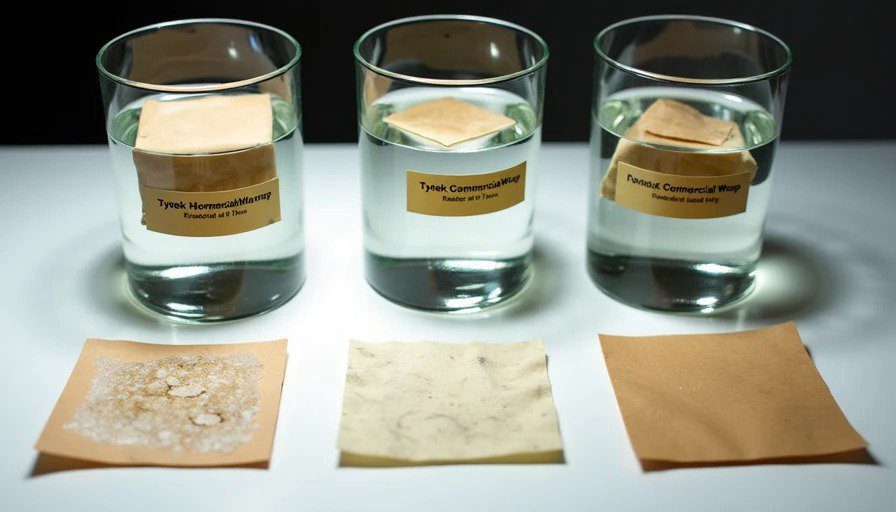
In the lab, we'd run a standard hydrostatic head test on membrane samples—basically a column of water, 55 cm high, applied to a clamped sample for a specified duration. It's a quick pass/fail. But I wanted to see what happens when water sits on the wrap for longer—days, not minutes.
So I set up a simple immersion test:
Cut 12-inch squares from three rolls:
Tyvek HomeWrap (the most common residential grade)
Tyvek CommercialWrap (the heavier-duty D-grade product)
Builder-grade poly wrap (generic, 9-mil, cheap)
Fully submerged them in a water bath. No pressure. Just immersion.
Checked them at 24, 48, and 72 hours for visible water penetration, delamination, and structural integrity.
Here's what I found.
The lab data: water resistance by immersion
At 24 hours:
All three samples were intact. The Tyvek HomeWrap showed slight surface wetting but no visible droplets on the other side of the membrane. The CommercialWrap was bone-dry on the back side. The builder-grade poly was also dry.
At 48 hours:
The Tyvek HomeWrap developed a small, wicking stain on the back side—not a droplet, but a slightly darker patch indicating moisture vapor had penetrated. CommercialWrap still dry. Builder-grade poly developed a slight dampness, likely through the microperforations.
At 72 hours:
HomeWrap: visible water droplets forming on the reverse side of the membrane at three distinct spots. The wrap was allowing bulk moisture across the barrier.
CommercialWrap: still watertight. A slight dampness at one corner, but no active droplets.
Builder-grade poly: completely saturated in patches. Water was moving through the microperforations and through the seam of the sample.
The immersion test told me something important: water resistance varies widely by grade. Tyvek CommercialWrap, at about twice the cost, is significantly more water-resistant than HomeWrap under continuous immersion. The builder-grade poly is barely a barrier after 48 hours—but even HomeWrap, the industry standard, starts letting water through after about 72 hours of continuous exposure.
What the field cut-open reveals
The immersion test is controlled, clean, and laboratory-perfect.
Field conditions are not.
Here's what I found when I cut open three different wall assemblies in the Denver area—houses built between 2014 and 2020, all with Tyvek HomeWrap, all installed by professional crews.
House 1: Aurora, 2014 build (10 years old)
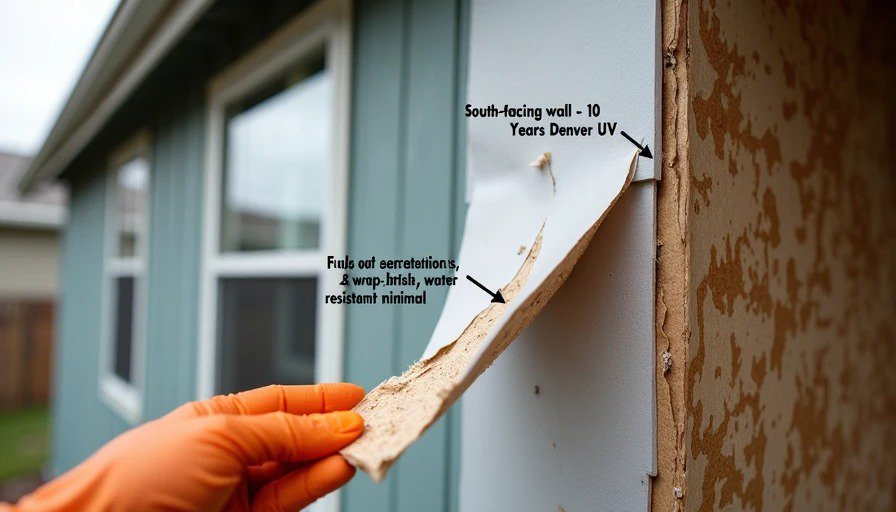
The Tyvek was still intact in most places, but at two corners of the south-facing wall, the wrap had degraded into a brittle, papery layer. I could press my finger through it with no resistance.
South-facing wall. 10 years of Denver UV. The wrap had lost nearly all structural integrity. It was still performing as an air barrier—barely—but it would not have stopped bulk water if the siding had been breached.
House 2: Lakewood, 2018 build (6 years old)
The wrap looked good from the outside—intact, flexible, with tape still adhered at the seams. But when I peeled back a section at the bottom of the wall, I found the wrap had delaminated from the sheathing in a 4-inch strip.
The cause was moisture trapped behind the wrap—hydrostatic pressure had built up between the wrap and the sheathing, eventually causing the wrap to pull away and create a pocket where water could collect. This was a south-facing wall as well, but the driver appeared to be freeze-thaw cycling, not UV. Water had wicked behind the wrap at the sill, then frozen overnight, expanded, and repeatedly pushed the wrap away from the sheathing.
The wrap passed the fingernail test—still flexible. But the air seal was broken at the bottom, and water could now run freely between the wrap and the sheathing.
House 3: Westminster, 2020 build (4 years old)
The wrap was pristine. I cut three openings in different walls and found the Tyvek intact, flexible, and properly taped at seams. The builder had installed it correctly, and the house orientation—primarily north-facing on the exposed side—had limited UV exposure.
The wrap was still fully functional after 4 years. It could have done another 4 easily.
The UV factor: what I've seen across multiple inspections
I haven't run a formal controlled UV aging test on house wrap—those are done by manufacturers in certified labs with expensive equipment. But I've cut open enough walls in the Denver area to have a strong field sample set.
Here's what I've consistently observed:
South-facing walls—the ones that get the most UV exposure—see measurable degradation starting around year 5 to year 6. The wrap becomes stiffer, more brittle, and loses its ability to self-heal around nail penetrations.
East and west-facing walls degrade more slowly, typically showing significant stiffness around year 8 to year 10.
North-facing walls show minimal UV degradation even at year 10—they're shaded by the house itself most of the year.
This matches the manufacturer's guidance. Tyvek HomeWrap is rated for 6 months of UV exposure in the field—that's the window you have before you need to cover it with siding. In actual service, behind siding, UV exposure is dramatically reduced. But UV still gets through gaps, and it degrades the wrap over years, not months. The material's resistance to bulk water decreases as the spunbonded polyolefin fibers become more brittle and more porous.
The degraded wrap I cut out of the Aurora house at year 10 had visible pinhole cracks that had formed along the creases where the wrap had been folded around corners. Water would have gone straight through those if the siding had been breached. The wrap was still blocking air, but water resistance was effectively zero.
The air barrier vs. water barrier distinction
Here's something most homeowners don't understand: house wrap serves two different functions.
Air barrier. This is the primary function. House wrap blocks air movement through the wall cavity, preventing drafts, reducing energy loss, and controlling condensation within the wall. This function is relatively durable—as long as the wrap remains intact and taped at seams, it will block air for decades.
Water barrier. This is a secondary function—and it's the one that fails first. The wrap is designed to stop bulk water from entering the wall cavity from the exterior. But its water resistance decreases over time: UV breaks down the polymer, freeze-thaw cycles stress the seams, and moisture trapped behind the wrap can cause delamination and adhesive failure.
When a homeowner asks me "how long does house wrap last?" I always ask: "Which function are you talking about?"
If you mean the air barrier, it will likely last the life of the siding. If you mean the water barrier, it's more like 5 to 10 years in real field conditions, depending on the exposure, orientation, and wrap grade.
Which wrap I spec—and why
Given what I've seen in the lab and the field, here's my current practice:
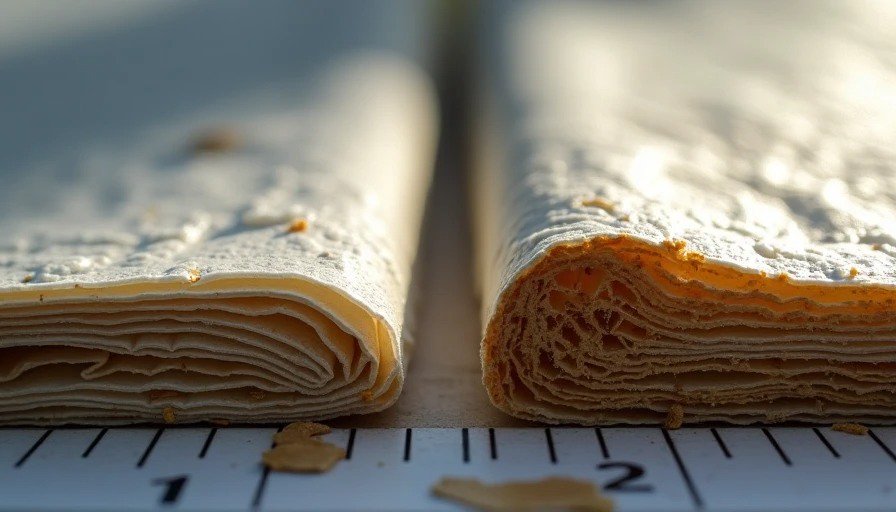
For standard residential jobs, I spec Tyvek CommercialWrap over HomeWrap. The additional cost is about 15-20% for the material, but the water resistance and UV durability are significantly better. The CommercialWrap's thicker, denser fibers resist degradation longer, and its water holdout is better under continuous exposure.
For high-exposure walls—south-facing, high altitude, no tree cover—I've started specifying a WRB with a dedicated drainage layer (like Benjamin Obdyke's HydroGap or similar). The drainage layer creates a capillary break between the wrap and the siding, allowing bulk water to drain down instead of saturating the wrap. This extends the water barrier's effective life significantly.
For any wall with stucco, I insist on a WRB that handles moisture better than standard house wrap—Tyvek CommercialWrap at minimum, but I prefer a fully adhered membrane if the budget allows. Stucco holds moisture against the wall for days after a rain, and the wrap needs to stay water-resistant longer than it would behind siding.
What to do if you can't re-wrap
If your house is older and you're not planning to reside anytime soon, there's still something you can do:
Seal the bottom of the wall. Most moisture intrusion through house wrap happens at the sill, where water can work its way behind the wrap and up into the sheathing. Seal the bottom edge of the wrap to the foundation with a high-quality sealant or tape—even if the wrap's water resistance is degraded at the top, the bottom gap is often the entry point for bulk water.
Check your siding's condition. House wrap fails as a water barrier only if the siding is breached. If your siding is intact and well-maintained, the wrap's degraded water resistance may never be tested. The more your siding requires maintenance, the more you should worry about your wrap.
Consider an air barrier test. A blower-door test will tell you if your house wrap is still functioning as an air barrier. If air is moving through the wall, the wrap has likely been breached somewhere—and water isn't far behind.
The honest answer
The honest answer to "how long does house wrap stay water-resistant" is: It depends on the grade, the exposure, and the installation.
In a lab, dry, perfect environment? Decades.
In a low-UV, well-protected wall? Ten to fifteen years for CommercialWrap; seven to ten for HomeWrap, based on my field sampling.
In a high-UV, south-facing wall with freeze-thaw stress and less-than-perfect installation? Five to seven years before water resistance begins to meaningfully decline.
I want to be precise: the wrap doesn't "fail" in a binary sense. It degrades. Water resistance gradually drops. Pin holes appear. Seams lift. The wrap stops behaving like a waterproof barrier and starts behaving like a very breathable air barrier.
That's the moment when the wall assembly's design—especially the flashings and drainage details—starts to matter much more than the wrap itself. If the flashing details are good, the wrap can degrade a lot and the house will still be fine. If the flashing details aren't solid, the degraded wrap becomes a second line of defense that might not hold.

No notes on this sheet yet.